What makes for a great leader in senior living? It may begin with operational knowledge and the ability to make sound decisions, but it goes much further. It is the ability to see potential in others, to earn trust, to set high expectations while providing support, and to understand that the strength of a community is ultimately rooted in the people who make it what it is.
For The Bristal Collection, those qualities are part of how leadership is cultivated, and how people are encouraged to grow, from the community first.
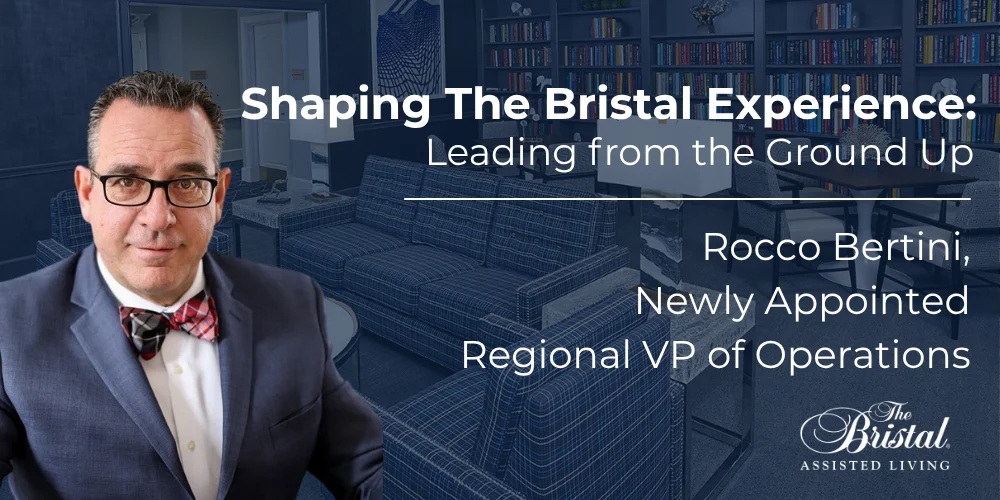
The recent appointment of Rocco Bertini as Regional Vice President of Operations offers one example of that philosophy in action. After serving as Executive Director for The Bristal at Bethpage, Rocco is taking on responsibility for eight communities, bringing with him years of experience leading teams, navigating change, and building relationships with residents, families, and team members.
His promotion is significant not simply because of the role itself, but because of what his progression represents: a commitment to developing talent, investing in people, and creating opportunities for team members to grow within The Bristal.
Rocco’s path from community leadership to a regional role reflects the kind of career development The Bristal seeks to foster, giving capable people the opportunity to take on greater responsibility, while supporting them along the way. His story also offers a closer look at the qualities The Bristal values in the leaders it develops.
People First
For Rocco, leadership begins with a simple principle.
“My leadership philosophy is rooted in the belief that people come first,” he says. “In senior living, that means every decision should ultimately be viewed through the lens of what is best for our residents and their families.”
It is a philosophy that has implications for everyone in a community. Residents want to feel known, respected, and heard. Families want confidence that their loved one is receiving thoughtful, dignified care. Team members need the resources, encouragement, and trust to do their work well.
When those needs are understood as interconnected rather than separate, leadership becomes less about managing from the top and more about creating conditions for everyone to succeed.
“A strong community starts with a strong team,” Rocco says. “When your team feels supported, appreciated, and connected, that translates directly into better care and stronger relationships.”
That connection between people and performance is an important part of leading a senior living community. As Rich Youngberg, Vice President of Operations, explains, “Effective community leadership requires attention to resident care and satisfaction, regulatory responsibilities, financial and operational performance, staffing and human capital, and – throughout it all – prioritizing the culture of the community.”
Asked what Rocco will excel at in his new role, Rich says, “The Regional Vice President of Operations has to cultivate a good team. They work closely with the Executive Director and department heads at their communities to understand what they need and how they can be supported.”
The focus on developing strong teams is also central to developing strong leaders. For The Bristal, investing in people means both recognizing that leadership potential can emerge at every level of the organization and giving people the support and opportunity to build on that potential.
Leading by Example
Support, however, does not mean lowering expectations. Strong leaders create clarity about what is expected and then demonstrate their willingness to be part of the work required to achieve it.
That was one of the qualities Rocco’s Bethpage colleagues noticed most.
“Rocco always leads by doing,” says Morgan, Culture Crew Chief at The Bristal at Bethpage. “He would never ask you to do something he wouldn’t do himself.”
This past winter, that meant spending hours alongside the Maintenance team clearing cars and the parking lot after snowfall, helping to make the community more accessible for residents, families, and team members.
It was a small example of a larger principle: leadership is often most visible in the moments that do not come with recognition or a title.
Rocco’s hands-on approach also helped him build credibility with a team that was going through change.
“When he started at Bethpage, he really went back to the grassroots level,” Rich says. “He got to know everyone – their strengths, their weaknesses, their opportunities, and where they needed help. He worked with every department.”
Being present gave Rocco a better understanding of both the challenges facing the community and the people who could help address them. It also reinforced a lesson that applies across The Bristal collection: leaders cannot effectively develop teams without first taking the time to get to know their team members.
And that investment works in both directions. The same environment in which leaders take the time to understand their teams can create opportunities for team members to demonstrate their own capabilities, build new skills, and prepare for what comes next.
Recognizing What Could Be
Leadership is not only about what a person accomplishes themselves. It is also about what they recognize in others, and what they are willing to do to help others succeed.
Sara Anne, Director of Community Relations at The Bristal at Bethpage, illustrated this.
Rocco first met Sara Anne at a networking event while she was working for a hospitality group. He saw potential in her for her role at The Bristal and encouraged her to pursue it. More than seven years later, she remains with the organization and says she loves her career.
For Sara Anne, the ability to recognize talent was accompanied by something equally important: a willingness to invest in it.
“Rocco is meticulous about this building and fair to his employees,” she said. “He expects excellence from his teammates, but if they have questions, he will take the time, sit down, and explain everything to them.”
That combination, high standards and genuine investment in people, is an important part of developing a strong team. It means giving people room to grow while making sure they have the guidance and support to meet the expectations placed before them.
It also creates a culture in which professional growth happens organically: a team member is encouraged to take on more, a leader recognizes emerging strength, and new paths open for advancement.
From Community Leadership to Organizational Growth
Rocco’s move into his new regional role brings that idea into sharper focus.
He began by leading one community. Now, he will have the opportunity to support leaders and teams across eight communities, applying what he has learned while continuing to grow into a different kind of leadership role.
But his role will not simply be imposing one formula across eight different teams.
“Every community has its own strengths and challenges,” Rocco says. “I think the opportunity is to identify what works, share best practices, and help teams find solutions that fit their unique needs.”
That perspective recognizes something fundamental about The Bristal: while communities share a common commitment to quality and care, each has its own personality, history, team, and relationships with the people it serves.
Regional leadership, then, is not simply about consistency. It is about helping individual leaders understand what their communities need, giving them the tools and perspective to respond, and sharing knowledge across the organization.
“I believe the best regional leadership is not about taking over, but about empowering leaders to be successful,” Rocco says.
That approach reflects the larger philosophy behind Rocco’s own progression. Growth within an organization does not happen simply because someone is given a new title. It happens when people are given opportunities to gain experience, supported as they take on new challenges, and trusted to put what they have learned into practice.
The Ripple Effect of Leadership
The impact of investing in people can extend well beyond an individual career path.
A leader recognizes potential in an employee. That employee develops new skills and takes on greater responsibility. A stronger team creates a stronger community. A stronger community creates better experiences for residents and families. And the people who have been supported in their own growth become better equipped to support others.
This is the ripple effect of leadership development.
Rocco’s move from Executive Director to Regional Vice President of Operations is just one example of that progression. The larger story is about the environment that makes such progression possible: one where people are given learning opportunities, leaders are encouraged to develop the talent around them, and experience gained at the community level becomes a foundation for broader responsibility.
As Rocco puts it, “Relationships matter as much as results.”
For The Bristal, that may be one of the clearest measures of leadership – not simply what a leader accomplishes personally, but what becomes possible for the people around them.
Because when an organization invests in its people, the impact does not stop with one promotion. It moves through the team, through the community, and ultimately to the residents and families who are at the heart of The Bristal Experience.